Why your split unit stops cooling in July — and the three checks to run first
The three things to check before you call anyone, and what each one means for the bill.
July in Riyadh is when we get the most calls, and a large share of them are the same complaint: the unit runs, air comes out of the vents, but the room never gets cold. Before you book anyone, there are three checks worth running. Two of them you can do yourself in ten minutes, and one of them decides whether this is a 90 riyal job or a 900 riyal one.
copper lines cold + sweating warm
1. The filter and the return air
Pull the front cover off the indoor unit and look at the filters. If they are grey and matted, that alone can cut airflow enough to stop the room cooling and, in a bad case, freeze the evaporator coil. Wash them in warm water, dry them fully, and run the unit for an hour before deciding anything else is wrong.
While the cover is off, check the coil fins behind the filter. If they are packed with dust, a filter clean will not be enough — that needs a proper coil wash, which is around 180 riyals and is genuinely the fix in maybe one call in five.
2. The outdoor unit
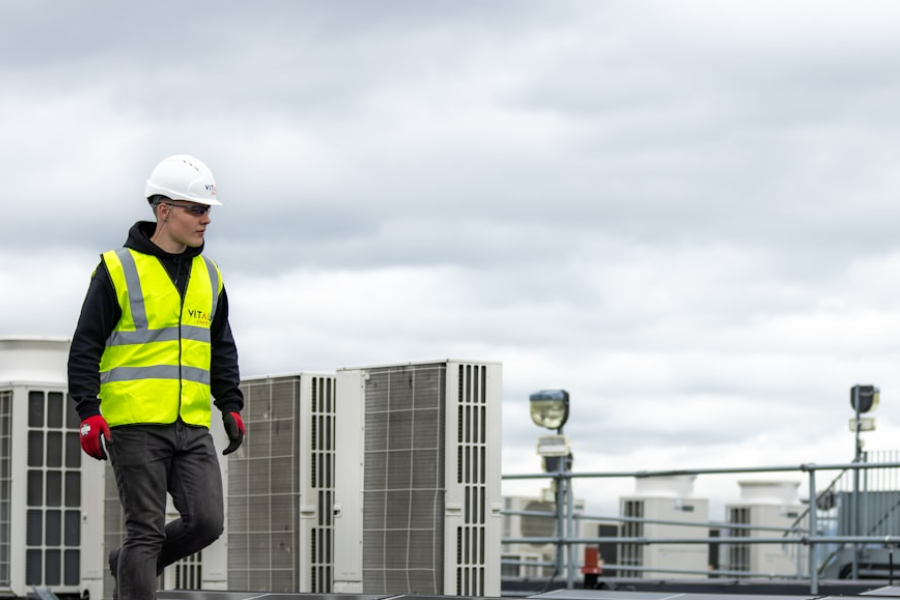
Go and stand next to the condenser. It should be running, the fan should be turning, and the air coming off the top should be noticeably hot. If the fan is not turning while the indoor unit is running, stop there and call someone — that is usually a capacitor, and running the compressor without the fan will damage it.
If the fan is turning but the air off the top is only lukewarm, the system is probably low on refrigerant. That is the third check, and it is the one that needs gauges.
3. The copper pipes
Look at the two copper lines running into the outdoor unit. The thicker one should be cold to the touch and lightly sweating in summer humidity. If it is dry and at ambient temperature, the charge is low. If there is ice on it, the charge is low or the airflow is restricted — go back and check the filters again.
Ice on the pipe is the single most common thing customers photograph and send us, and it almost always means the same thing: the system has lost gas through a leak. Which brings us to the part that decides the bill.
What a leak actually costs
Refrigerant does not get used up. If the charge is low, it left through a hole, and topping it up without finding that hole means paying again in a few months. A proper repair is: trace the leak with an electronic detector, repair or replace the failed joint or component, pull a vacuum, then recharge to the weight printed on the unit's data plate.
On a typical split system, a traced and repaired leak with a full recharge runs 350 to 600 riyals. A recharge alone is cheaper, and any technician who offers you one without looking for the leak is selling you the same repair twice.
When it is not the gas at all
Two other faults produce the same symptom. A failed capacitor stops the compressor from starting while the fan keeps running, so air still moves but nothing cools — that is usually 120 to 250 riyals. And a thermostat or control board reading the wrong temperature will cycle the compressor off early, which feels like weak cooling. Both are quick diagnoses for anyone carrying a multimeter.
The short version
Clean the filters and run it for an hour. Check the outdoor fan is turning and the air off the top is hot. Feel the thick copper pipe. If the filters were dirty, you may have just fixed it for free. If the pipe is dry or iced, you have a leak, and the number to remember is 350 to 600 riyals for a repair that actually holds.